Baseball Alphabet: A Designer’s Real-World Embroidery Review
First Impressions: Bold, Playful—and Immediately Recognizable
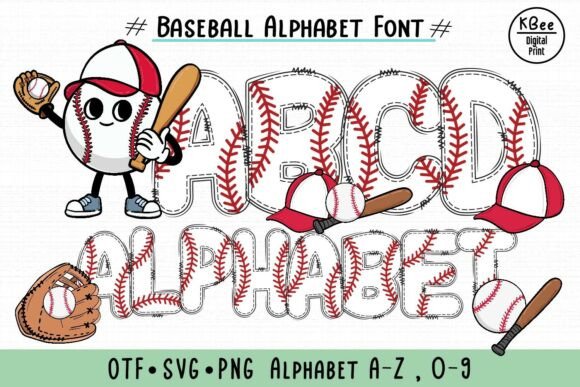
Opening Baseball Alphabet for the first time, I felt that familiar spark: not just “cute,” but characterful. This isn’t a generic sports font—it’s stitched with intention. Each letter carries the visual language of a baseball: thick outlines mimicking stitching, subtle seam curves across curves and diagonals, and a confident, rounded boldness that reads clearly even at 1.5 inches tall. It lands somewhere between vintage team signage and a kid’s handmade jersey—warm, energetic, and unmistakably athletic. As a designer who regularly selects fonts for embroidered tote bags, baby onesies, and boutique aprons, I immediately pictured it on a canvas lunchbox or a cotton twill cap—not as decoration, but as identity.
Real Project Test: A Custom Embroidered Tote for a Little League Coach
Last week, I used Baseball Alphabet to stitch “TEAM JAX” across the front of a natural canvas tote—intended as a gift for a local coach. The result? Instant smiles. Parents recognized the theme before reading the letters; kids pointed and said, “That’s a baseball!” That’s the power here: Baseball Alphabet doesn’t just spell words—it tells a story in thread. The red-stitch effect translated beautifully using 40-weight rayon in classic red over cream fabric, with clean satin stitch edges holding shape without bleeding. No floating threads, no skipped stitches—even through the tight curve of the “J.” It performed like a well-engineered machine embroidery design, not a novelty font dressed up for digital display.
Where It Shines (and Where It Asks for Care)
Baseball Alphabet excels on medium-to-heavyweight fabrics where stitch definition matters: sweatshirt embroidery, embroidered patches, tea towels, pillow covers, and nursery decor. Its generous line weight and open counters make it forgiving on textured surfaces—like terry cloth towels or looped cotton blankets—without sacrificing legibility. On baby embroidery projects, it adds charm without looking juvenile, especially when paired with simple monograms or tiny mitts motifs.
That said, it’s not universally low-effort. On stretchy fabric (think ribbed knit tees), I recommend a cutaway stabilizer and reduced top tension—those bold seams need structural support. On dark fabric, avoid light thread unless you’re layering underlay; the satin stitch density benefits from contrast. And skip it for curved cap fronts under 2.5 inches tall—the small “i” dot and seam details compress awkwardly in tight hoops. It’s also not ideal for dense multi-line text blocks; this is a headline font, not body copy. Use it for names, team tags, slogans, or single-word holiday embroidery—not ingredient lists on kitchen towels.
Design Integrity Meets Customer Trust
When your Etsy seller or craft fair customer sees Baseball Alphabet stitched cleanly on a personalized gift, they don’t just see letters—they register care, cohesion, and craft intention. That visual consistency builds trust: if the font feels authentic to the theme (sports, childhood, community), buyers assume the same attention went into thread quality, hoop alignment, and finishing. I’ve watched customers pause longer over items using Baseball Alphabet versus generic block fonts—especially on custom apparel and boutique products. It elevates the handmade product from “nice” to “meaningful.”
Practical Notes Every Embroidery Designer Should Check
- Test on scrap first—especially with your go-to stabilizer combo. Baseball Alphabet’s satin stitch borders respond noticeably to backing choice.
- Review stitch density before scaling down. At under 1.25 inches, some inner seam curves may lose definition.
- Confirm hoop size compatibility. While flexible, very large versions (over 4 inches wide) may require re-hooping mid-design on smaller machines.
- Inspect corners and joins in your embroidery software. Look for smooth transitions—not jagged vector artifacts masquerading as stitch paths.
- Mock it in black and white before finalizing thread colors. The red-seam illusion relies on contrast—verify it holds on both light and dark fabric previews.
- Use proper stabilizer—especially for lightweight cottons or layered garments like reversible aprons.
- Check licensing before selling finished products or bundling Baseball Alphabet as part of a digital embroidery file pack. As a Fonts category design, its commercial use terms matter for craft business owners and digital product sellers.
Beyond the Stitch: Branding, Gifting, and Long-Term Value
I’ve used Baseball Alphabet across three distinct contexts recently: a set of personalized baby embroidery onesies for a boutique launch, a series of embroidered patches for a youth league’s end-of-season gifts, and a holiday embroidery collection featuring “HOME RUN HOLIDAYS” on linen pillow covers. In each case, it strengthened the narrative—not just “embroidered,” but curated. Customers didn’t ask, “What font is that?” They said, “This feels like *us*.” That emotional resonance translates directly to perceived value, repeat orders, and word-of-mouth referrals.
For Etsy sellers and small shop owners, Baseball Alphabet works because it’s distinctive without being obscure. It’s searchable (“baseball font”), yet feels hand-selected—not algorithmically generated. When paired with thoughtful printable mockups or lifestyle photos showing real use (a child holding the tote, a coach wearing the cap), it becomes an asset—not just a design.
A Final Thought: Design With Purpose, Not Just Pattern
Baseball Alphabet isn’t about adding “sporty” to a project. It’s about anchoring a handmade product in authenticity. Whether you’re stitching a graduation gift for a college pitcher, branding merchandise for a summer camp, or designing a digital embroidery file for fellow crafters, this font earns its place by performing reliably—and connecting meaningfully. It’s proof that great embroidery fonts aren’t just readable. They’re memorable, tactile, and quietly confident. And in a crowded market of digital design assets, that’s the real home run.