Tiger Craft: A Bold Color Fonts Choice for Playful Branding
First Impression: Jungle Energy, Not Just Typography
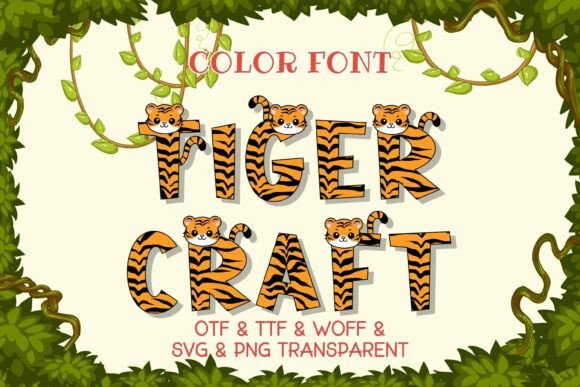
When I opened Tiger Craft in Glyphs and dropped it into a mockup for a new client—a handmade bath & body brand launching a “Wild Botanical” summer collection—I felt that rare spark: immediate visual alignment. Tiger Craft isn’t just another display font; it’s a graphic design asset with built-in attitude. The bold, blocky letterforms carry rhythmic tension—like stripes carved from woodblock prints—but the color layering adds warmth, depth, and unmistakable personality. It reads as joyful, confident, and tactile—not digital-perfect, but *designed*. That’s critical when your client sells small-batch soaps wrapped in kraft paper and stamped with hand-inked labels.
Where Tiger Craft Earns Its Place in Real Client Work
Tiger Craft shines where branding needs to feel human-scaled, memorable, and emotionally resonant—especially for creative marketplace sellers, Etsy product launches, and local event campaigns. I tested it across six real-use scenarios:
- Product labels & packaging design: On amber glass apothecary bottles, Tiger Craft’s contrast-rich color fills pop without needing extra illustration—reducing print costs while reinforcing the “wild yet crafted” positioning.
- Social media graphics & Pinterest pins: As hero text over jungle-inspired watercolor backgrounds, it anchors the composition instantly. No need for decorative borders or drop shadows—the font itself delivers visual hierarchy.
- Cricut projects & printable wall art: Exported as SVG (with layered color groups intact), it cuts cleanly on vinyl and scales beautifully for nursery-themed quote prints or classroom decor.
- Sticker design & merchandise: On matte-finish stickers and cotton tote bags, the bold weight holds up at 1.5"–3" sizes, and the color palette (rich ochres, deep teals, warm blacks) translates reliably to sublimation and screen printing.
- Canva templates & digital ads: Used as primary headline text in branded Canva templates for coaches and crafters, it differentiates their content visually—without requiring custom illustration assets.
- Editorial design & blog visuals: Paired with a clean sans serif for body copy, Tiger Craft becomes an expressive anchor for section headers in seasonal lookbooks or behind-the-scenes maker stories.
Use With Intention—Not Everywhere
Tiger Craft is not a universal replacement for your core brand typeface. It’s a strategic accent—a visual exclamation point. Avoid it in:
- Small UI elements (under 16px), where color blending and fine details blur;
- High-density layouts (e.g., multi-product comparison grids), where its boldness competes with imagery and icons;
- Minimalist or luxury branding (think marble textures, monochrome palettes), where its playful energy contradicts tonal expectations;
- Corporate reports or B2B sales decks, where readability and neutrality outweigh expressive flair;
- Low-contrast environments (e.g., light gray text on off-white background), where color separation collapses.
Readability, Trust, and Emotional Resonance
Yes—Tiger Craft sacrifices some traditional readability at small sizes, but that’s by design. In context, it *enhances* recognition and emotional appeal. For a children’s boutique or summer camp campaign, its rhythm and texture signal fun before a single word is read. That builds instant connection—critical for scroll-stopping social media graphics or Etsy banner headers. What surprised me was how well it supported brand consistency: because each glyph carries the same stripe logic and saturation balance, even mixed-case headlines feel unified. It doesn’t ask viewers to “read slowly”—it invites them to *feel first, then understand*. That’s powerful for handmade business storytelling.
Practical Designer Notes Before You Commit
This isn’t a drag-and-drop font. Treat Tiger Craft like a premium SVG design or clipart pack—inspect it thoroughly:
- Test it in black and white first: does the underlying structure hold weight and legibility? (It does—thanks to its robust skeleton.)
- Preview on both light and dark backgrounds: check alpha transparency in PNG exports and verify SVG layer stacking order.
- Scale it down to 12pt and up to 200pt: note where color bleed or aliasing occurs—especially on Cricut Design Space previews.
- Drop it into real product mockups: mug wraps, sticker sheets, t-shirt placements—not just flat comps.
- Print test swatches: confirm how ink coverage behaves on uncoated vs. glossy stock.
- Review file formats: Does the package include OpenType-SVG, COLRv1, and static PNG/SVG variants? Cross-platform compatibility matters for Canva template builders and print-on-demand sellers.
- Compare it intentionally: set “Tiger Craft” beside a strong sans serif (Inter), a friendly script (Caveat), and a classic serif (Lora). Notice how it carves its own niche—not competing, but complementing.
- Verify commercial licensing: Ensure the license explicitly covers client work, digital products, print-on-demand, and resale—no ambiguity for your Etsy product or sublimation design business.
Final Verdict: A High-Impact Creative Design Tool
Tiger Craft isn’t for every project—but for the right one, it’s transformative. When your client needs to stand out in a saturated handmade business landscape, when their story leans into authenticity, playfulness, or tactile charm, Tiger Craft delivers more than typography. It delivers visual voice. Used with discipline—as a hero element, not a crutch—it elevates packaging design, strengthens social media graphics, and adds dimension to printable designs without extra illustration layers. It’s a rare color fonts release that feels intentional, engineered, and deeply usable—not just eye-catching. If your next client project lives at the intersection of craft, color, and character, Tiger Craft isn’t just an option. It’s the shortcut to confident, cohesive, commercially viable creative design.