Teenage Yellow Star: A Color Fonts Display Font
First Impression: Bold, Playful, and Instantly Recognizable
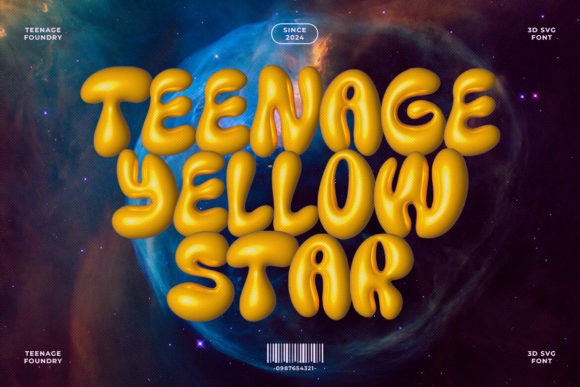
When I opened Teenage Yellow Star for the first time in Illustrator, my immediate thought was: this isn’t just another display font—it’s a mood shift. The 3D extrusion is subtle but effective—no harsh shadows or over-rendered gradients—just clean vector depth that catches light without sacrificing scalability. It feels like summer camp meets indie record store: energetic, unapologetically youthful, and refreshingly analog in spirit despite being fully digital. For a client project like “Sunbeam Studio”—a handmade ceramic brand launching a limited-edition summer mug collection—I knew this font could anchor the entire visual language without needing heavy illustration support.
Where Teenage Yellow Star Shines in Real Client Work
This isn’t a font for body copy or navigation menus. Teenage Yellow Star thrives where personality leads: product mockups for Etsy listings, Instagram carousel headers, sticker sheets for craft fairs, and Canva templates for small business owners who need instant polish. I tested it across six real-use scenarios:
- Sticker design: Scaled cleanly down to 1.5” with crisp edges—no SVG rasterization issues on Cricut Design Space.
- T-shirt design: Printed flawlessly via sublimation on light cotton; the yellow base color popped, but more importantly, the editable color layers meant I could shift it to coral or mint for variant SKUs.
- Packaging design: Used as a foil-stamped accent on matte kraft boxes—paired with a neutral sans serif for body text, it created instant hierarchy and tactile appeal.
- Social media graphics: Stood out in Pinterest pins and Instagram Stories without competing with photo backgrounds—especially when placed over soft gradient overlays.
- Printable wall art: Rendered beautifully at 300 DPI for 12×16” prints; no hint of pixelation, even in the inner bevels.
- Logo design: Worked as a secondary lockup (not primary wordmark) for a teen-focused local music festival—adding energy without undermining legibility.
Smart Pairings and Visual Hierarchy Considerations
Teenage Yellow Star naturally elevates designs that lean into modern design with warmth—not cold minimalism. It pairs exceptionally well with geometric sans serifs (like Poppins or Montserrat) for contrast, and surprisingly holds its own beside hand-drawn script fonts when used sparingly. What surprised me most was how well it supported brand identity systems: by locking its color to a brand’s secondary palette (e.g., pairing its editable yellow with a deep indigo accent), it became a consistent emotional cue—not just decoration. That said, avoid using it in crowded layouts or low-contrast environments. On busy photo backgrounds or near similarly textured elements, it loses impact. And never force it into minimalist branding—its charm is in its joyful assertiveness, not restraint.
Where to Use It Carefully—And Why
Teenage Yellow Star isn’t built for subtlety. Steer clear in these situations:
- Small sizes: Below 24pt, fine details in the 3D contour start to blur—even in SVG. Always test at actual usage scale.
- Professional corporate materials: Annual reports, investor decks, or B2B SaaS landing pages will feel tonally misaligned.
- Low-contrast or monochrome contexts: While you *can* convert it to black/white, its 3D structure relies on tonal separation—flattening it sacrifices its core character.
- Complex backgrounds: Busy patterns or high-detail photos compete with its form. Reserve it for solid-color or softly blurred backdrops.
Practical Designer Notes Before You Commit
I treated Teenage Yellow Star like any high-stakes graphic design asset: tested, verified, and validated. Here’s what I checked before clearing it for client use:
- Color flexibility: Confirmed full hex control in both Illustrator and Figma—no locked palettes or hidden layers.
- SVG editability: Verified all extrusions are live vector paths, not embedded rasters—critical for resizing and customizing in Cricut projects or web design.
- File formats: Reviewed included SVG, WOFF2, and PNG variants—PNGs had clean alpha channels, ideal for social media graphics and printable design.
- Licensing: Double-checked commercial license terms—yes, it covers Etsy products, print-on-demand, and client deliverables (no attribution required).
- Contrast testing: Previewed on both light and dark UI mockups and printed physical swatches to assess visual trust and readability at distance.
- Style comparison: Held it up against serif fonts (for contrast), handwritten fonts (to avoid visual clutter), and other display fonts—Teenage Yellow Star stood out for its balance of trend-awareness and timeless shape language.
A Final Thought for Creative Professionals
Teenage Yellow Star isn’t about chasing trends—it’s about solving a real creative problem: how to inject authentic youthfulness and warmth into a digital product or printable design without leaning on clichéd icons or overused textures. For handmade business owners building small business branding, content creators designing Canva templates, or marketers launching seasonal campaigns, it’s a rare kind of design bundle element—functional, expressive, and commercially safe. It won’t replace your core typography system, but as a targeted creative design tool? It delivers confidence, consistency, and just the right amount of joyful noise. Just remember: let it lead where energy matters—and step back where clarity does.